
How to Buy Trailer Parts from China: A Sourcing Guide
Buying trailer parts from an overseas factory for the first time raises the same questions every new customer asks us: how do you check quality before the container ships, what's a fair MOQ, can you mix part types in one box, and what actually happens between placing the order and the parts landing at your port. This guide walks through how to buy trailer parts from China from the supply side of the desk, so you know what to ask for and what to expect at each stage.
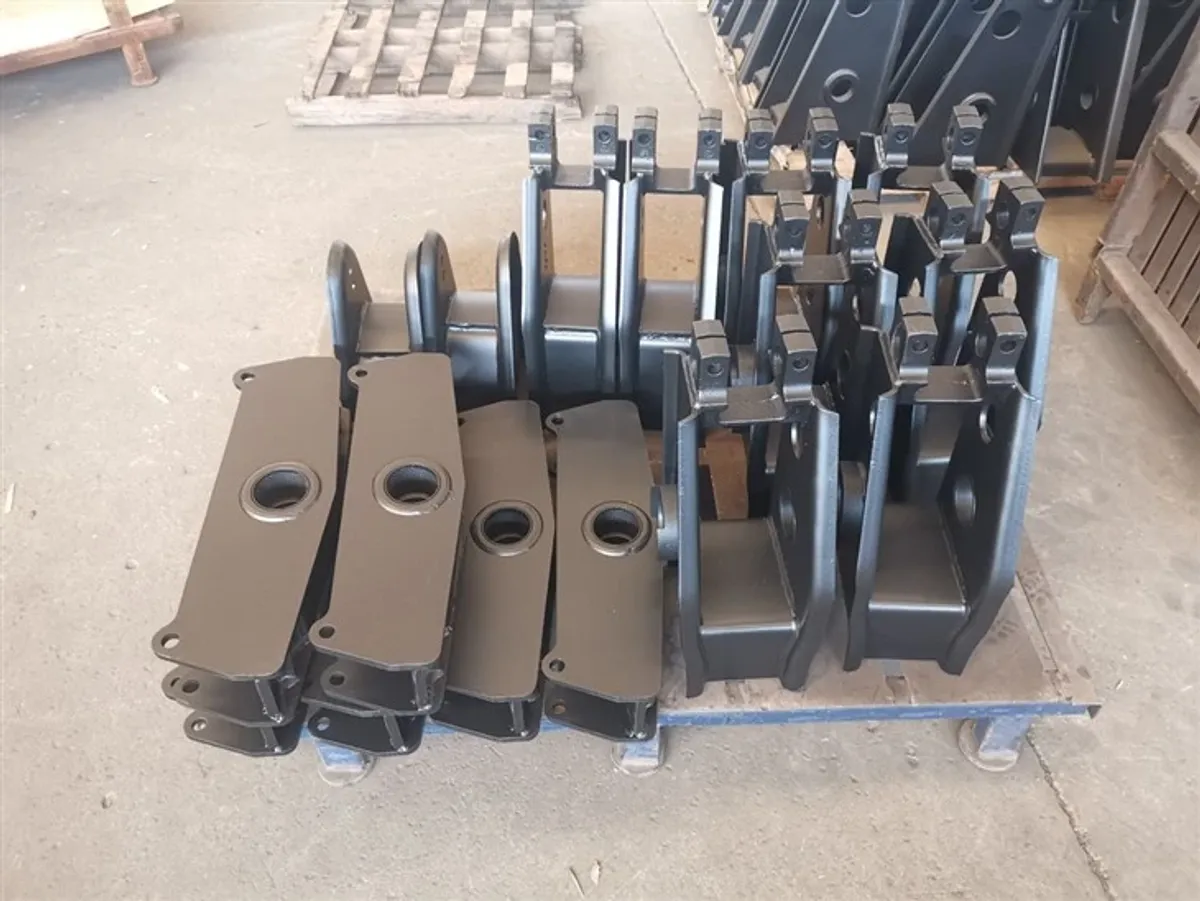
Trailer Parts Sourcing: Supplier at the Source vs Middleman
Trailer parts sourcing from China generally runs through one of two channels: a middleman working a province away that resells parts from multiple factories, or a supplier based in the production cluster itself, close enough to the forging, casting and assembly lines to answer for what comes off them. A middleman can be useful for very small or one-off orders, but every layer between you and the shop floor adds margin to the price and a step of delay to any technical question — if a customer asks about axle track width tolerance or brake drum hardness, a distant reseller has to relay that question down the chain and relay the answer back, and sometimes gets it wrong in translation.
Buying trailer parts from China through a supplier sitting inside the production cluster means source pricing without a reseller's margin stacked on top, and it means the person answering your technical questions can walk in and check the part the same day. It also means one party is accountable for the whole order rather than a chain that can shift blame to whichever unnamed workshop actually produced a defective batch.
Trailer Parts Quality Inspection Before Shipping
Trailer parts quality inspection should happen well before a container gets sealed, not after it arrives at your port when there's nothing left to do but file a claim. A serious supplier should be willing to send photos or short videos of dimensional checks on critical parts — axle beam straightness, brake drum diameter, king pin diameter — along with material certificates showing the steel grade and heat treatment actually used. For larger orders, it's worth paying for a third-party pre-shipment inspection service; the cost is small relative to a full container and gives you an independent set of eyes confirming what the supplier reports.
Ask specifically what inspection happens at each production stage, not just at the end. Every batch of axles, brake components, and couplings we ship goes through incoming material checks, dimensional inspection, and finished-part testing before it reaches our warehouse, and we're glad to share that documentation with any buyer who asks before placing an order — a supplier reluctant to show inspection records before you commit to a purchase order is a signal worth paying attention to.
OEM vs Aftermarket Trailer Parts
OEM vs aftermarket trailer parts isn't simply a premium-vs-budget price tier — it's a decision about fitment guarantee and design ownership. OEM parts are made to the exact specification of the original trailer builder, often under license or to drawings the builder controls, and are guaranteed to fit and perform identically to what came on the trailer originally. Aftermarket parts are made to match the same fit and function through independent engineering and reverse measurement, without the original builder's drawings.
For most fleet maintenance and distributor stock, well-made aftermarket parts perform indistinguishably from OEM at a meaningfully lower cost, provided the manufacturer has done the reverse-engineering carefully and tests to the same load and durability standard. The risk sits with aftermarket parts made cheaply to approximate dimensions without real testing — that's where fitment problems and premature failures show up. When we quote aftermarket fifth wheel couplings or king pins, we test them against the same load and fatigue standards as OEM parts precisely because the aftermarket label shouldn't mean lower engineering rigor, just a different design origin.
Trailer Parts MOQ and Mixed Container Loading
Trailer parts MOQ is usually set per part category based on production batch efficiency — a factory running a casting furnace or forging press wants enough volume to make a production run worthwhile. This is where mixed container loading becomes the practical solution for distributors and fleets restocking multiple categories at once: instead of hitting a full MOQ on axles, a separate MOQ on brake drums, and another on landing gear, a single consolidated supplier exporting the full range can combine smaller quantities of each into one container that meets the overall shipping minimum.
This is one of the clearest arguments for consolidating trailer parts sourcing with one export supplier rather than several — a buyer who needs 20 axles, 40 brake drums, and 15 landing gear sets doesn't have to place three separate orders each straining to hit its own MOQ; it becomes one container loaded to the ratio the buyer's stock actually needs. If you're weighing whether to consolidate suppliers, ask your supplier directly what their mixed-loading policy is and whether MOQ applies per category or per container.
Trailer Parts Shipping and Supplier Selection
Trailer parts shipping from China typically moves by sea freight in standard 20ft or 40ft containers, with lead time driven by production schedule first and transit time second — a rushed production run is a bigger risk to part quality than a few extra days at sea. Ask any prospective supplier for their typical production lead time separately from shipping transit time, and get both in writing before placing a deposit, since vague combined estimates are where delivery delays hide.
Final trailer parts supplier selection should weigh export experience as much as price — a factory that has actually shipped to your region knows how to pack for a month at sea and rough inland handling after the port, and knows which certificates your customs broker will actually ask for. Ask for references from buyers in your own country or a similar market, request the specific export documentation you'll need, and confirm the factory has shipped the specific part categories you're ordering, not just a general trailer parts catalog.
Using a Maintenance Checklist and Parts Diagram to Plan an Order
Most buyers don't sit down and work out what to reorder from scratch — they work off whatever trailer maintenance checklist already governs their fleet's PM schedule and translate the failed or worn line items directly into a parts order. A typical semi trailer maintenance checklist walks a technician through brake stroke and lining thickness, landing gear crank effort, king pin wear, suspension bushings, and lighting in a single pass-fail pass at every service interval, and whatever gets marked as failed is exactly what ends up on the next purchase order to a manufacturer. A tractor trailer maintenance checklist covering the whole combination — tractor and trailer together — works the same way from a parts-ordering standpoint, since the trailer-side items on it (axles, brakes, suspension, coupling) are the ones a trailer parts supplier actually fills; the tractor-side items just go to a different supplier.
Some fleets formalize this further into a trailer maintenance & safety inspection form that a driver or shop mechanic signs before a trailer is dispatched, with a separate parts-needed column that feeds straight into procurement. Whatever a fleet calls it — a trailer maintenance form, truck and trailer maintenance forms, or a full inspection form — the same failed-item-to-part mapping applies. That form is worth sharing with a manufacturer when placing a mixed-container order, since it maps each failed item directly to a part category instead of making the supplier guess at what's actually needed. It also helps to have a tractor trailer semi trailer parts diagram on hand when translating checklist line items into the correct part name — "landing gear" on a checklist could mean the whole leg assembly, just the gearbox, or just the crank handle, and a labeled diagram avoids ordering the wrong sub-component or the wrong quantity of each. We're glad to send a parts diagram alongside a quote so a buyer can confirm exactly which component on the trailer corresponds to which line on their maintenance checklist before the order is finalized.
Container Consolidation Reference: Typical 20GP & 40HQ Loading Capacities by Trailer Part Category
| Part Category | Full 20GP Capacity | Full 40HQ Capacity | Pre-Shipment QC & Export Packaging |
|---|---|---|---|
| Complete Trailer Axles (13T–16T) | 58–62 axles | 120–140 axles | Track width, camber & bearing preload check; steel-strapped bundles of 3–4 |
| Mechanical & Bogie Suspensions | 45–60 sets | 100–130 sets | Hanger plate thickness & weld MPI check; palletized hardware + bundled springs |
| Leaf Spring Packs (60Si2Mn) | 22–26 tonnes (~400 packs) | Weight-limited to 26–28 tonnes | Camber height & Rockwell hardness (HRC 42–48) test; steel-banded pallets |
| 28T Two-Speed Landing Gear | 180–210 pairs | 360–400 pairs | High/low gear engagement & static proof check; cross-strapped wooden pallets |
| Fifth Wheel Couplings (2″ / 3.5″) | 80–110 sets | 180–220 sets | Kingpin go/no-go jaw gauge test; pre-greased on fumigated export pallets |
| 22.5″ Steel Wheel Rims & Tires | 480 rims or 240 tires | 1,050 rims or 580 tires | Radial/lateral runout check; mounted or doubled/tripled tire-in-tire loading |
Frequently Asked Questions
Is it better to buy trailer parts directly from a supplier at the source or through a middleman?
How do I inspect trailer parts quality before the container ships?
Should I buy OEM or aftermarket trailer parts?
Can I mix different trailer part types in one container to meet MOQ?
What should I check before selecting a trailer parts manufacturer?
How do I find a trailer parts supplier and import from China?
Tell us the part you need and your destination port — we'll send specs & a quote today.
Reply within 24 hours — or WhatsApp us at +86 199 5331 6215.